Year in Review Template for Your Personal Life, Not Your Performance Review
Year in review template for your personal life: 12 prompts across six areas, each answered from what you already logged, plus a 90-minute order to run them in.
By Notion Life OS by Cosmo Suite · Editorial policy
Published · 7 min read
Search for a year in review template and much of page one is presentation decks and whiteboard boards, many built for company roundups. Those suit a team presentation, but they offer little assistance when you want to examine your own personal year.
A personal year in review is 12 questions across the areas of your life, answered from what actually happened, followed by three choices for next year. The prompts below take about 90 minutes in total when your year is already logged. Each answer comes from a filtered view instead of from memory.
A review written from memory depends on whatever you happen to recall. Ordinary months disappear, unless you kept a Notion workspace that logs your tasks, goals, habits and money all year for the review to read.
Year in Review at a Glance
The 12 prompts group into six areas, two per area, and each one has a definite source for its answer.
| Area | Prompt 1 | Prompt 2 | Where the answer comes from |
|---|---|---|---|
| Planning | What did I finish? | What kept slipping? | Done tasks and projects, overdue tasks |
| Goals | Which goals moved most? | Which never started? | Goal progress views |
| Wellness | Which habit held all year? | Which dropped first, and when? | Habit check rollups by month |
| Lifestyle | What did I read, watch, travel to? | What did I buy and regret? | Reading list, travel, shopping |
| Learning | What did I learn that I use now? | What did I start and drop? | Courses and notes |
| Finance | Where did the money go? | Which budget line ran over most? | Expense and budget reports |
Each area gets one prompt about what went right and one about what didn't, so the weaker areas get examined too.
What Does a Year in Review Connect To?
A year in review connects twelve months of small entries to next year's goals. It's the one review that reads every hub simultaneously.
That only works if the individual entries are linked. Consider a completed task that belongs to a project, a project that serves a goal, and an expense that sits under a budget line. Each of those links is a relation. A relation is the Notion property that ties a row in one database to a row in another. A rollup is a property that counts or sums across those links, which is how a goal page knows that 9 of its 12 steps are done. Notion's help center covers both in its relations and rollups guide.
With the links in place, your year in review mostly involves opening views. Without them, expect an afternoon of scrolling.
[Unique insight] The wiring for this review. The prompt-to-view map below is our own design for the Notion Life OS review page.
| This page | Feeds | Through |
|---|---|---|
| Done tasks | "What did I finish?" | A filter: status done, date this year |
| Goal progress | "Which goals moved most?" | A sort by progress rollup |
| Habit checks | "Which habit held?" | A rollup of checks per month |
| Expenses | "Where did the money go?" | A group by budget category |
How to Set Up the Review Page
Make one page called "Year in Review 2026" and put 12 linked database views on it, each filtered to this year. That page is the entire template, and you never duplicate any data into it.
- Create the page inside your Planning hub, next to the yearly planner.
- Add a linked view per prompt. A linked view is a view of an existing database placed on another page, with its own filters. Notion's guide to linked databases confirms that filters and sorts you add there don't change the original database.
- Filter each view by date: created or completed between 1 January and 31 December.
- Sort for the question. "Which goals moved most?" sorts by progress, highest first. "What kept slipping?" filters overdue tasks and sorts by due date.
- Leave a text block under each view for your answer, three lines at most.
Notion's views, filters and sorts guide shows each of these settings step by step. Once the page exists, duplicate it next December and change the year in the filters. Database templates can also repeat on a yearly schedule, if you'd rather have Notion create the page for you.
Which Prompts Should You Answer First?
Answer the completed-work prompts first and the financial prompts last. Starting with what went right makes the review less likely to become a list of regrets before you've seen the whole year.
First 30 minutes: Planning and Goals. Estimate how many tasks you completed this year and write the estimate down. Then open "What did I finish?" and count. Next, sort goals by progress percentage. You may discover a goal sitting at 8 of 10 steps that you'd completely forgotten, which is encouraging information before the harder prompts.
Next 30 minutes: Wellness and Learning. Examine habit checks by month rather than as one annual total. A habit checked on 7 of every 10 days can hide a strong spring and a collapsed autumn. The month it dropped usually corresponds to something visible on your calendar.
Last 30 minutes: Lifestyle and Finance. Group expenses by category and compare each against its budget line. Then answer the lifestyle prompts, which typically explain the financial ones.
For example, say the dining-out line had a $150 monthly budget and the year's total came to $2,400. So the line finished $600 over. Grouping those expenses by month shows whether it was a steady $50 a month or two expensive months. The lifestyle prompt then supplies the reason, such as a move, a new job or a trip. A steady overspend means the budget was set too low; two expensive months may be a one-off you don't need to fix. Both answers take a minute when the expenses are already grouped, and both change next year's budget.
A Worked Example: One Goal Across the Year
[Original data] Take a goal set in January: run a 10K in March, with 12 weekly action steps related to it. The numbers below are sample data, not a real person's.
| Month | Steps done (rollup) | Progress |
|---|---|---|
| January | 4 of 12 | 33% |
| February | 9 of 12 | 75% |
| March | 12 of 12 | 100% |
(Sample goal, January to March 2026.) In the review, this goal answers "Which goals moved most?" without any writing. What happened afterwards is more revealing. Suppose the running habit's monthly checks fall from 12 in March to 2 in May. Then the goal was achieved but the habit wasn't maintained. The lesson concerns keeping a habit after the goal is achieved, which a review from memory usually misses.
The review's final step turns findings like that into next year's three goals, each with its own action steps. Next December's review then has something to read.
What Makes a Year in Review Worth Doing?
A year in review is worthwhile when it changes your behavior in January. A review that ends in a reflective paragraph and no decisions leaves January looking like last year.
Stop something. The last prompt in every area is a candidate for stopping, such as the habit you never kept, the course you never finished, or the subscription line that ran over. Eliminating one activity frees more time than adding a goal.
Keep three goals, not ten. Each new goal should originate from a prompt answer, not from a list you wrote beforehand.
Log what next year's review will need. If a prompt was difficult to answer, that area wasn't being logged. Consistent logging is worth the effort. A 2016 meta-analysis of 138 studies in Psychological Bulletin, covering 19,951 participants, found that monitoring goal progress promoted goal attainment. The effects were larger when progress was physically recorded. Fix that gap first, in your own setup or in a planner template with hubs for habits, goals and finance. A Life OS where every hub feeds the review runs on the same idea, with the system doing the remembering.
How We Made and Checked This
We're the Cosmo Suite team that built and sells the Notion Life OS template, so we have a stake in the conclusion. Methodology: the 12 prompts, the 90-minute order and the review page are our own design. The 10K and dining-out examples use sample numbers, not a real person's data. Descriptions of relations, rollups, linked views and filters come from Notion's help center. The progress-monitoring finding comes from the Psychological Bulletin meta-analysis cited above. Everything was checked on 3 October 2026, but Notion updates its features, so check the current steps before building. The screenshots show our template with sample data. You can read who we are and how to contact us and how we write and fact-check posts.
Where Notion Life OS Fits
The 12 prompts work in any application. They take 90 minutes when you have a year of linked entries to read from.
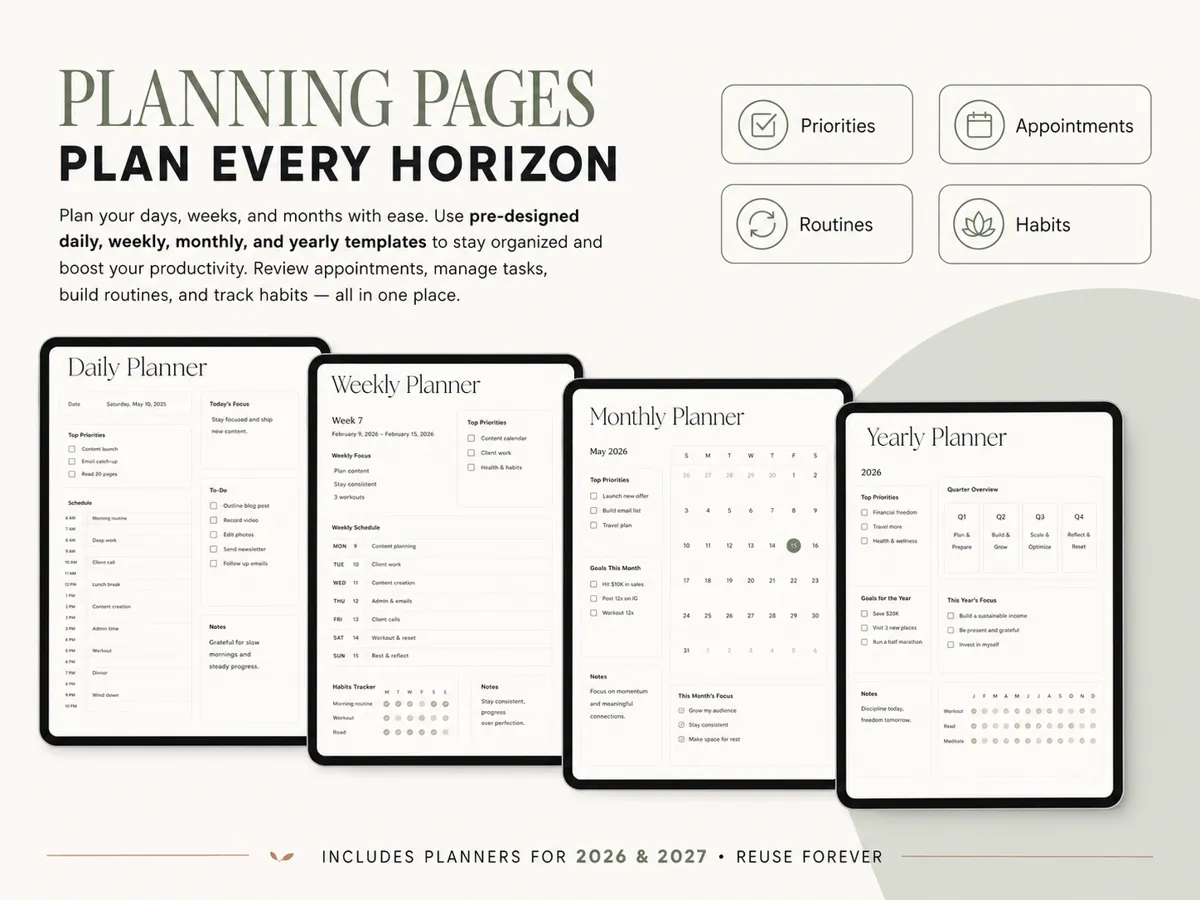
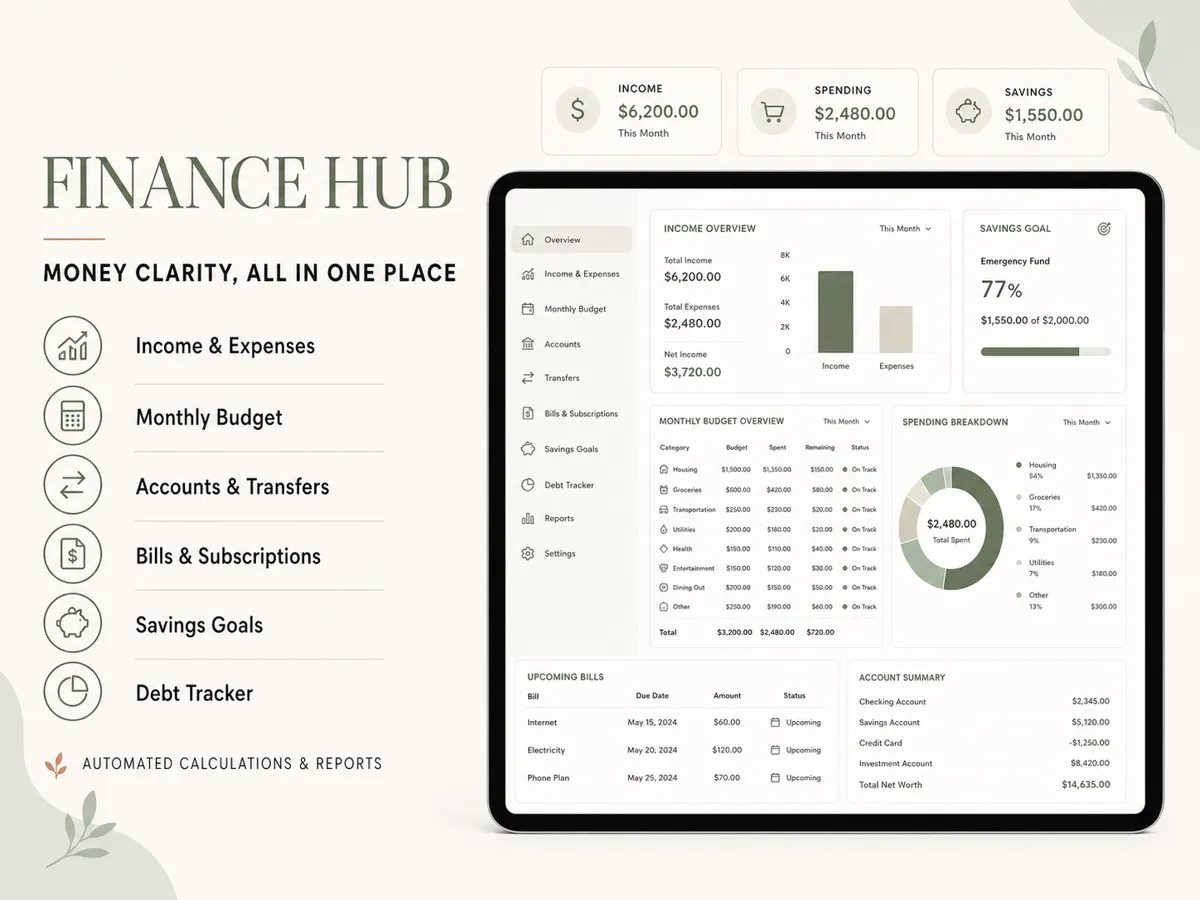
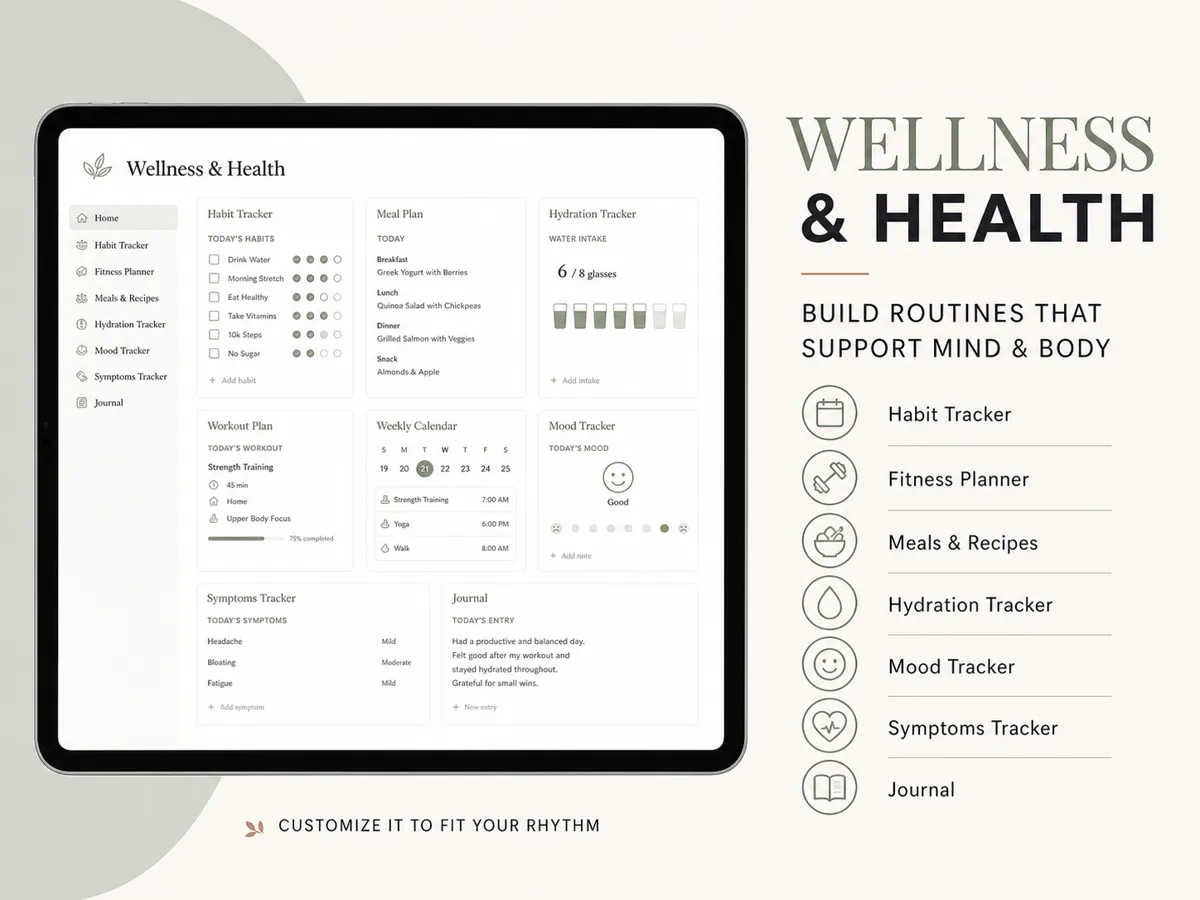
Notion Life OS gives you the hubs to log into, and you can wire the relations above into them gradually. Its Productivity & Planning hub has daily, weekly, monthly and yearly planners. Goals & Vision breaks each goal into action steps with progress views. Wellness & Health tracks habits and health, and Lifestyle holds your reading, shopping and travel lists. Learning covers courses and notes. Finance tracks income, expenses, budgets and savings with automated reports.
All six hubs sit in one template of 60+ hyperlinked pages, with a central dashboard and a synced master calendar. It works on a free Notion account and includes a video tutorial with written instructions. It costs $9 once, with free lifetime updates.
If you set it up now and log consistently, next December's review page will be mostly complete. You can explore each hub in the six-hub Notion template with yearly planners.
Frequently asked questions
When should I do a personal year in review?
Any time in the last two weeks of December or the first week of January works, as long as you block 90 minutes for it. Some people prefer their birthday or the start of a school year. What matters is doing it once a year at the same point, so each review compares a full twelve months.
How long does a year in review take?
About 90 minutes if your year is already logged, and closer to half a day if you rebuild it from memory and old photos. The 12 prompts in this post take 5 to 10 minutes each when the answers come from filtered views. The slowest part is usually the final step, choosing what to stop.
Can I use this template if I didn't track anything this year?
Yes. Answer each prompt from your calendar, bank statements and photos instead of from views. It takes longer and the answers are rougher, but it still works. Use the gaps you notice as the brief for next year: whichever prompt was hardest to answer is the area to start logging in January.
What is the difference between a year in review and a performance review?
A performance review is written for an employer and grades your work against your role. A personal year in review is written for you and covers every area of life: health, money, learning, relationships and goals. Many templates on the first page of Google are built for teams and company roundups, which is why this one exists.
Should a year in review include goals for next year?
Yes, but only at the end and only three of them. Set them after you've looked at what moved and what didn't, not before. Each new goal should come out of a prompt answer, such as a habit that held or a budget line that kept running over.
What is the fastest way to set up a year in review in Notion?
Use a workspace where tasks, goals, habits and money are already logged and linked, then make one page with 12 linked views filtered to this year. Notion Life OS includes yearly planners, a Goals & Vision hub with progress views and a Finance hub with reports, for a one-time $9.
